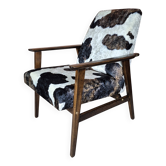
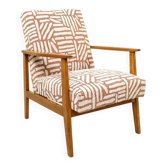
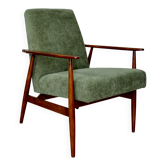
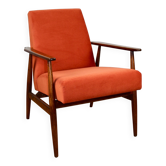
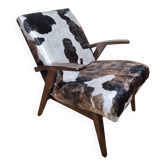
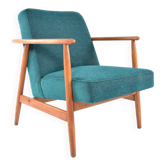
Restored Mid-Century Armchair Type B-7727 - Cowhide Print Velour - 1960s

- Dimensions :
- H75 x L63 x P69
- Couleur :
- multicolore
- Matériaux :
- lin
- Style :
- mid-century
We are pleased to offer a fantastic piece of Eastern European Mid-Century Modern design: the armchair type B-7727. Produced in the 1960s by the Radom Furniture Factories in Poland, this model is highly appreciated for its clean lines and ergonomic profile. It shares a striking resemblance to the famous 300-190 "Lisek" chair but features its own unique, slightly more geometric frame and armrest design. Design and Comfort. The chair boasts a beautiful, light wooden structure with distinctive compass legs and gracefully sculpted armrests. The ergonomic angle of the backrest provides excellent support and remarkable seating comfort, making it a perfect addition to a living room, reading corner, or an eclectic bedroom. Restoration and Materials. This armchair has been completely and professionally restored from the ground up in our specialized workshop. The solid wood frame was carefully stripped of its original, damaged varnish. It was then stained in a warm, elegant walnut color and finished with premium hard wax oil. This treatment protects the wood while highlighting its natural grain and providing a smooth, satin touch. The entire internal seating structure, including all belts and upholstery foams, has been replaced with brand new, high-quality materials to ensure modern comfort and durability. For the upholstery, we chose a premium, soft velour fabric featuring a bold cowhide animal print. This unexpected, playful pattern gives the classic mid-century silhouette a contemporary, eclectic edge. Dimensions: Total Height: 75 cm. Width: 63 cm. Depth: 69 cm. Seat Height: 43 cm. Style: Mid-Century Modern, Vintage, Eclectic. Period: 1960s. Origin: Poland. Materials: Solid Wood, Velour Fabric.
Selency raconte le fauteuil club
Un peu d'histoire ? Comme son nom ne le dit pas, ce fauteuil en cuir ultra « comfy » est une création française. Né à la fin des années 1920, celui qu'on appelle au départ « fauteuil confortable » devient rapidement la star des Gentlemen’s Club londoniens et parisiens, dont il aurait fini par prendre le nom.
On vous conseille de ne pas l’encombrer de coussins : plus il est brut, plus il est culte.
On aime les rides qu’il acquiert au fil du temps et participent à son charme. À entretenir, donc, avec modération.
L'info crousti 🍿
L’une des versions les plus populaires du club, le Fauteuil club Moustache, est apparue dans les années 1930. Elle devrait son nom à la forme du haut de son dossier, très similaire à celle de la moustache du président Georges Clémenceau. #aupoil.
Fauteuil club : autres pièces vintage similaires
Voir d’autres produits similaires- -10%
- -12%
- -10%
- -14%
- -15%
- -10%
- -10%
- -10%
- -21%